
 Add your solution
Menu

Digital Product Passport for fashion: a step-by-step preparation plan for 2027
Short answer: to prepare for the Digital Product Passport (DPP), treat it as a product data project, not a labelling job. Name an owner, take an inventory of the product data you already hold, make your product identifiers consistent, test a data carrier such as a QR code on a small range, start structured supplier data collection with tier 1, and choose software that keeps your data portable. Do not lock in item-level tags, label layouts or a full textile data list yet: those details will only be fixed in the textile delegated act, which the European Commission plans to adopt in 2027.
This article is the project plan. For what the law says, the timeline and the kinds of data the Commission has mentioned, read our Digital Product Passport for textiles guide. To see where you stand today, try the free DPP readiness checker.
This article reflects official EU sources and standards bodies as they stood on 15 November 2026. It is not legal advice.
Where things stand, briefly
The legal framework exists, but the textile rules do not. The Ecodesign for Sustainable Products Regulation (ESPR), Regulation (EU) 2024/1781, sets general requirements for every passport. Textile-specific requirements will come in a future delegated act, and the Commission says companies will get a transition period of at least 18 months after an ESPR delegated act is adopted. Meanwhile the EU infrastructure is being built: the DPP Registry went live on 20 July 2026, and six European DPP standards have been cited in the Official Journal. For dates and detail, see the DPP guide and our EU rules hub.
Step 1: name an owner and set the scope
The Commission says the primary responsibility for creating a passport, and for its accuracy, rests with the economic operator placing the product on the EU market. ESPR Article 9 adds that passport data must be accurate, complete and up to date. Give the work one owner with time and a mandate.
- Your role. Work out where you act as manufacturer, importer or distributor. The Commission says manufacturers, producers or importers placing textile apparel on the EU market will mainly carry the obligation, while distributors and dealers must ensure a passport is available for what they sell.
- Your channels. If you sell online or through retailers, note it. ESPR Article 10 requires the operator placing a product on the market to give dealers and online marketplaces a digital copy of the data carrier or identifier, free of charge and within five working days of a request.
- Your pilot range. Pick one category with stable suppliers and long-running styles, such as a core basics line.
Step 2: take an inventory of your product data
Before you buy anything, find out what data you already have, where it lives and how reliable it is. Composition may sit in tech packs or the PLM, product copy in the e-commerce platform and supplier details in spreadsheets and email.
Use the kinds of information the Commission has already flagged for textiles as your headings (they are listed in our DPP guide), and record five things for each:
| Column | What to record | Why it matters |
|---|---|---|
| Source system | PLM, ERP, PIM, e-commerce, spreadsheet, supplier email | Shows how many systems a passport would need to draw from |
| Level | Style, colourway, size, batch or item | The delegated act will decide which level applies |
| Owner | The team that creates and updates it | Accuracy needs a named person, not a shared folder |
| Evidence | Certificate, test report, supplier declaration or none | Data you cannot support is a risk in a public passport |
| Gap | Missing, partial or complete | Turns the inventory into a work plan |
The Commission notes that fibre composition is required under the Textile Labelling Regulation, so it is a good first test of whether your systems agree. Evidence for claims such as recycled content belongs in the same exercise; our Learn pages on recycled content and textile certifications explain what the common documents prove.
Step 3: make your identifiers consistent
ESPR Article 10 says a passport must be connected through a data carrier to a persistent unique product identifier. Article 9 leaves it to each delegated act to decide whether passports are set at model, batch or item level. For textiles, that choice has not been made.
So the practical task now is consistency, not new hardware:
- One code per product, everywhere. Check that style, colour and size codes match across PLM, ERP and e-commerce.
- Check your existing barcodes. ESPR Annex III refers to the ISO/IEC 15459 family of standards for identifiers and names the Global Trade Identification Number (GTIN) as one example. If you already assign GTINs per SKU, record how and by whom.
- Prepare for batch data. Make sure production orders can be linked to the products they made.
- Supplier and facility identifiers. Article 12 says that where a supplier or facility has no unique identifier, the operator creating the passport must first check with that actor that none exists, then request one on its behalf. Collecting accurate legal names and addresses now makes this easier later.
The European standard on identifiers, EN 18219, is one of the six standards cited in Implementing Decision (EU) 2026/1736. See QR, NFC or RFID: DPP data carriers for clothing explained for identifiers and carriers in more depth.
Step 4: test a data carrier on a small range
Under ESPR Article 10, the data carrier must be physically present on the product, its packaging or accompanying documentation, as the delegated act specifies. The act will also set the layout and positioning (Article 9). The Commission’s textile page gives a QR code as an example and says the passport should also be accessible at online points of sale.

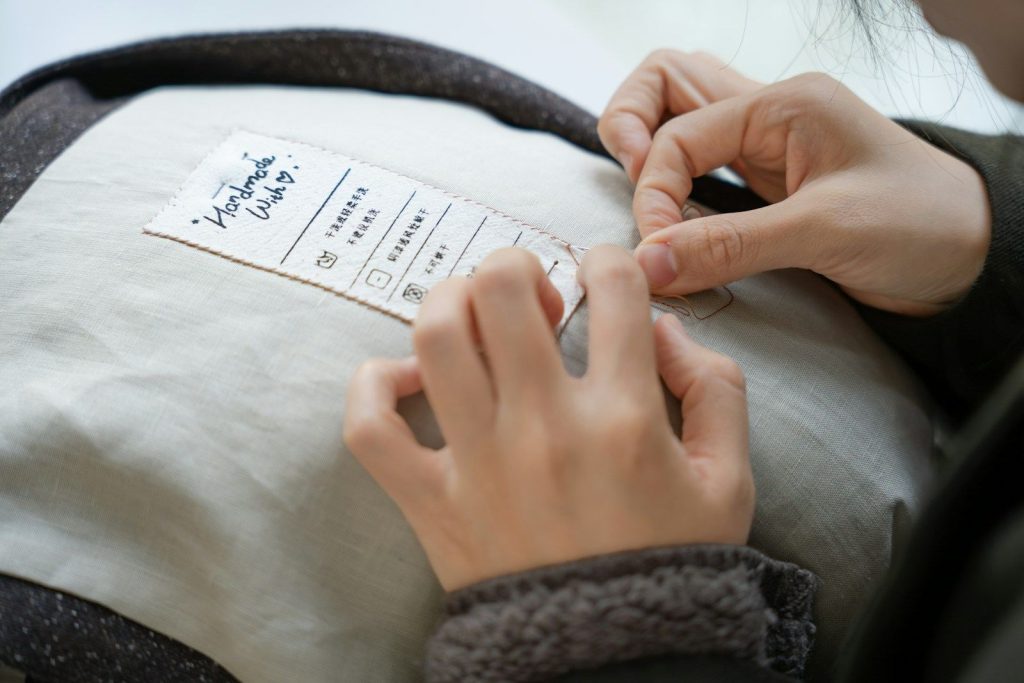
Put a QR code on the hangtag or care label of your pilot range and check:
- whether it still scans after washing, if it is on a sewn-in label;
- how much label space it needs, and what your label suppliers can print;
- whether the link behind it can stay live for years. Article 11 says passports must remain available for the period the delegated act sets, even if the company that created them becomes insolvent or stops trading, so do not print links to pages you may delete;
Keep the pilot reversible: the textile carrier rules do not exist yet.
Step 5: start collecting supplier data
Much passport data starts upstream, so supplier data collection is usually the slowest step. The Commission notes that some supply chain actors may themselves have to provide relevant information that is available to them.
- Begin with tier 1. Confirm the factories that make each pilot product, with full names and addresses, then work back to fabric mills.
- Use one template. Ask every supplier for the same fields in the same format, with the evidence attached.
- Agree it in writing. Add data-sharing expectations to supplier agreements.
- Plan for confidentiality. Who may see which data will be set at product group level (ESPR Articles 10 and 11). The European standard on access rights and business confidentiality, EN 18239, was published by CEN and CENELEC in September 2026.
Step 6: choose software that keeps your data portable
You do not need a DPP platform to run Steps 1 to 5. When you choose one, the ESPR already sets the bar:
- No lock-in. Article 10 requires passport data to be based on open standards, interoperable, machine-readable where appropriate and transferable without vendor lock-in.
- Back-up and storage. Article 10 requires the operator to make a back-up copy of the passport available through a DPP service provider. Article 11 says the passport is stored by the operator or by service providers.
- Your data stays yours. Article 11 says service providers must not sell, reuse or process passport data beyond what the service needs, unless agreed with the operator.
- Registry connection. The Commission says passports can be registered through a user interface or an API, and it has published technical guides and a test environment for the Registry.
Questions to ask any provider: which of the cited standards (EN 18216, EN 18219, EN 18220, EN 18221, EN 18222, EN 18223) does the product support; can it pull data from your PLM, ERP and e-commerce systems or will you re-key it; can you export everything in a standard format if you leave; and how will it handle model, batch and item level once the textile act decides. Note that the Commission’s timeline also plans a separate delegated act on DPP service providers in 2027.
Compare providers in our DPP and traceability software directory and our best DPP software for fashion guide. One example is Portia, which says it builds passport data where products are developed (styles, materials, tier-1 suppliers and certificates) and publishes passports behind QR codes per style, batch or item. Disclosure: Sustain 20 and Portia share the same owners.
Step 7: connect the passport to your circular services
The Commission expects passport information to help downstream operators with repair, reuse and recycling. If you run a repair programme, resale or a take-back programme, ask those partners which product data would make their work easier, and add it to your inventory. ESPR Article 11 also says a new passport for a product that already has one must link to the original, which matters for resold or refurbished items.
What is not decided yet
Avoid spending on anything that depends on these open questions.
| Open question | Where it will be decided |
|---|---|
| The binding data list for textiles | Textile delegated act and technical specifications |
| Model, batch or item level | Textile delegated act (ESPR Article 9) |
| Type of data carrier, layout and position | Textile delegated act (ESPR Articles 9 and 10) |
| Who may see and who may update which data | Textile delegated act (ESPR Articles 9 and 11) |
| How long passports must stay available | Textile delegated act (ESPR Article 9) |
| Any extra data stored in the EU Registry | Textile delegated act (ESPR Article 13) |
| Rules for DPP service providers | A separate delegated act, planned for 2027 |
| Legal status of EN 18239 and EN 18246 | Citation in the Official Journal; the Commission’s indicative timeline lists this for November 2026 |
| The date textiles must comply | Follows adoption of the textile act, with at least 18 months’ transition |
A realistic plan for 2027
- Now to early 2027: owner named, pilot range chosen, data inventory done, product codes cleaned up, tier-1 supplier data template sent.
- During 2027: QR pilot on one range, supplier data extended to fabric mills, software shortlisted with a portability test.
- When the textile act is adopted: compare its data list, level and carrier rules with your inventory, close the gaps and plan the roll-out within the transition period.
Frequently asked questions
When will fashion brands need a Digital Product Passport?
There is no fixed date yet. The Commission plans to adopt the textile delegated act in 2027 and says companies will have a transition period of at least 18 months after adoption. See our DPP guide for the official timeline.
What should a fashion brand do first to prepare?
Name an owner and take an inventory of the product data you already hold: where it lives, who owns it, what evidence supports it and what is missing.
Do I need RFID or item-level identifiers?
Not yet. ESPR leaves the choice of model, batch or item level to each delegated act, and the textile act has not been adopted. Start by making product codes consistent across your systems.
Will a QR code on the label be enough?
The Commission gives a QR code as an example of a data carrier, but the carrier type, layout and position for textiles will be set in the delegated act. A QR pilot now is a useful test, not proof of compliance.
Do I need DPP software now?
No law requires it for textiles today. If you choose a tool, check that your data stays portable: the ESPR requires passport data to be based on open standards and transferable without vendor lock-in.
Who is responsible if I sell through retailers and marketplaces?
The operator placing the product on the EU market carries the main responsibility. Distributors and dealers must ensure a passport is available, and the operator must give dealers and online marketplaces a digital copy of the data carrier or identifier on request. As of 15 November 2026; not legal advice.
Sources
- Regulation (EU) 2024/1781 (ESPR), Articles 9 to 13 and Annex III, Publications Office of the EU.
- European Commission, Digital Product Passport (including the indicative DPP timeline) and Textile apparel and the DPP.
- European Commission, DPP for economic operators and The DPP Registry.
- European Commission, The Digital Product Passport Registry is now live, 20 July 2026.
- Commission Implementing Decision (EU) 2026/1736 on harmonised standards for digital product passports, 14 July 2026.
- CEN and CENELEC, Digital Product Passport, the cornerstone for the implementation of sustainability and circularity on the European Single Market, 15 July 2026.
- UNI (Italian standards body), publication of EN 18239 and EN 18246 (in Italian).
- Portia, Digital Product Passport software, accessed 15 November 2026.
Related on SUSTAIN20™: Digital Product Passport for textiles · DPP readiness checker · DPP and traceability software · ESPR and the destruction ban · What to do with unsold clothes · Software category · Design for transparency and traceability
Header image: Photo: byhome work / Unsplash
